
The quality of the guests’ experience begins long before they arrive at the reception. Knowing how to reach the ceremony, where to park, and how long it takes to travel between the different venues allows them to take part in the day with greater peace of mind. Transport management is therefore an important aspect of the planning process, especially when the wedding involves venues located far apart or guests travelling from other cities.
Planning transportation means considering people’s needs, the characteristics of the area, and the timing of the ceremony. A clear schedule reduces uncertainty and helps avoid delays that could affect the sequence of planned events.
Organizing transportation does not simply mean choosing a means of getting to the venue. It means creating a simple and easy-to-understand journey for the guests, taking into account distances, convenience, and possible logistical difficulties.
Assessing distances and guests’ needs
The first step is to check where the ceremony and reception will take place, how far apart they are, and what transport connections are available. It is also important to consider the presence of hotels, railway stations, airports, and other arrival points used by the guests.
Guests’ needs may vary. Some may arrive in their own cars, others may prefer a shared transport service, while those staying in accommodation facilities may need a dedicated transfer. Gathering information makes it possible to understand which solutions would be most useful.
The local conditions must also be taken into account. Narrow roads, historic town centres, limited parking, or difficult routes may require specific directions and longer travel times. It is not enough to rely on the distance in kilometres: the realistic time required for the journey must also be assessed.
Shuttles and Group Transfers
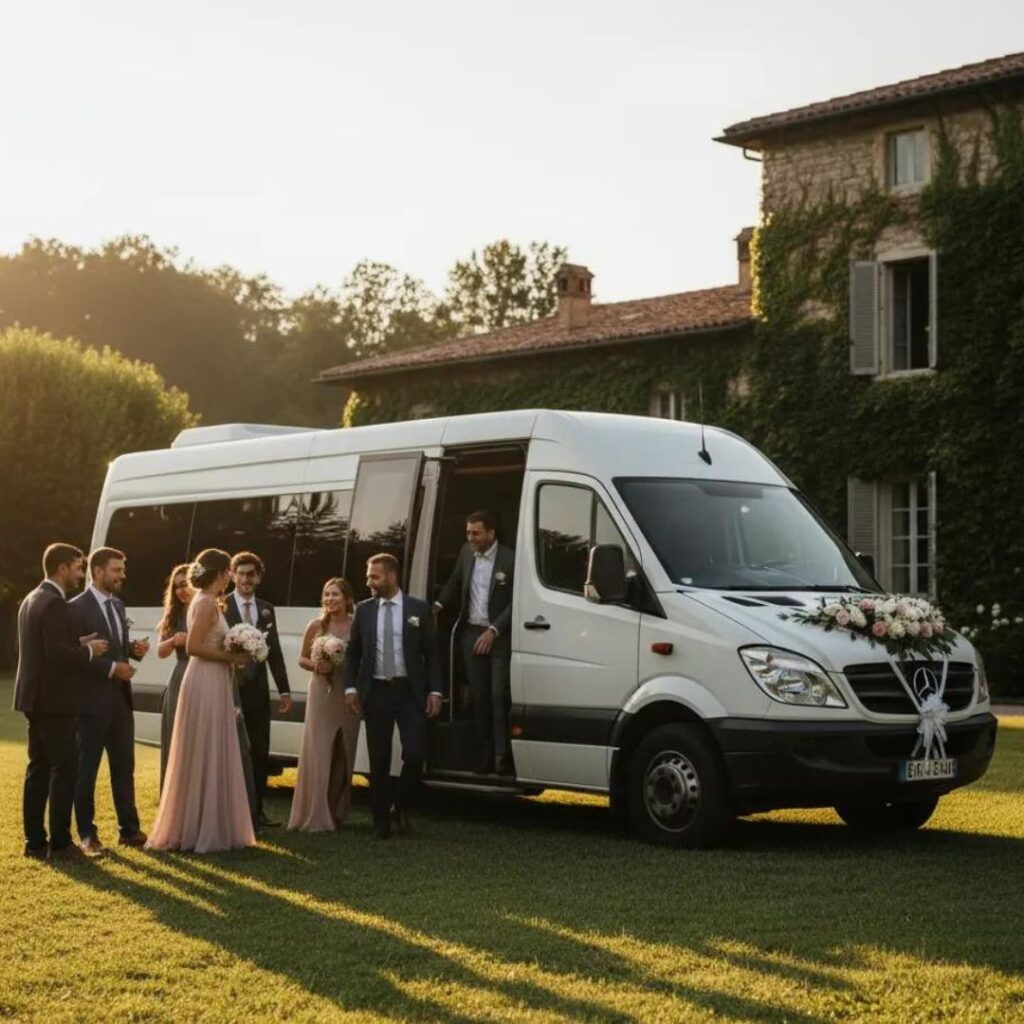
When many guests need to reach the same destination, a shuttle can be a practical solution. The service can be organised from a meeting point, an accommodation facility, or an easily accessible location, with departure times and return arrangements established in advance.
Before confirming the service, it is useful to check the vehicle capacity, the approximate number of passengers, the planned stops, and the duration of each journey. It is also important to clarify whether return transfers are available at different times, especially when the reception continues late into the evening.
Coordination with the driver and the event organisers helps manage any changes. Guests must receive clear information about the departure point, the time, and the contact details to use in case of need.
A well-organised shuttle service can simplify transportation and reduce the need for numerous cars. Its effectiveness, however, depends on realistic schedules, clear communication, and a careful assessment of the guests’ needs.
Parking, Access and Safety
For those attending the wedding by car, parking availability is an aspect that should be checked in advance. It is advisable to know the capacity of the parking area, any access restrictions, and the distance between the parking area and the ceremony or reception spaces.
If the venue is located in a historic town centre or in an area with traffic restrictions, guests must receive clear and up-to-date directions. In some cases, it may be necessary to identify a drop-off point and arrange a transfer for the final part of the journey.
Planning should also take into account guests with reduced mobility, older guests, and anyone who needs closer access to the entrance. Solutions must be verified with the venue and transport providers, avoiding reliance on assumptions.
Clear Communication Before the Wedding
Transportation information can be included on the wedding website, in communications to guests, or in a practical document sent before the event. It is useful to include addresses, parking information, shuttle schedules, and contact details for any questions.
If the schedule includes multiple transfers, a brief outline of the planned timings can help guests organise themselves. The information should be updated in the event of any changes to avoid conflicting instructions.
For Filomena D’Amelio, logistics are an integral part of hospitality. Coordinating distances, schedules, and services means allowing the couple to focus on the celebration and guests to enjoy it with greater peace of mind.
Careful transport planning makes the wedding more accessible and enjoyable. When journeys are planned thoughtfully and information is communicated clearly, even a complex route can become easy to navigate, contributing to the smooth flow of the entire day.